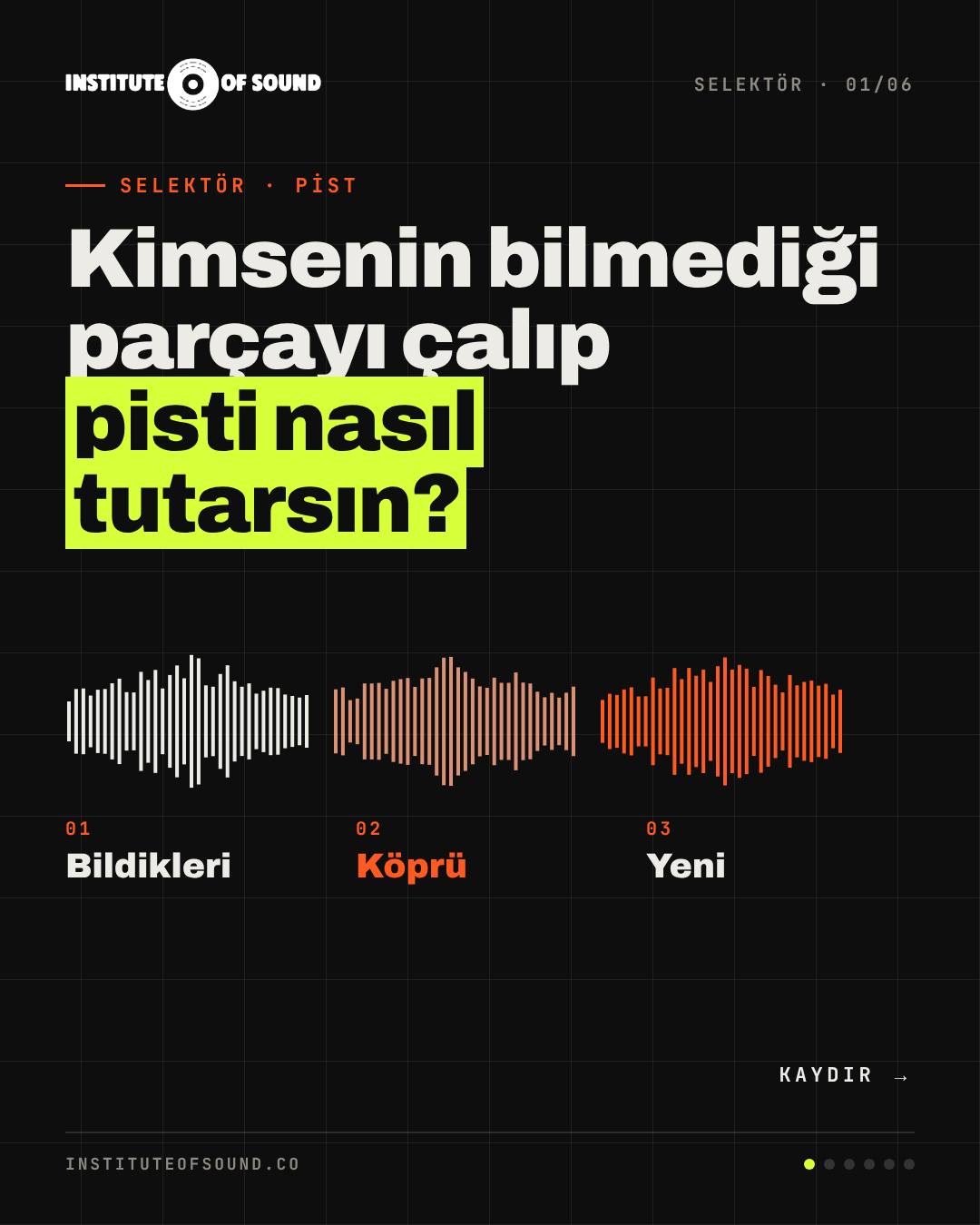


How do you keep the dancefloor while playing a track nobody knows?
How do you keep the dancefloor while playing a track nobody knows?
Every DJ carries a love of discovery. Finding a track nobody has heard, playing it to a full floor and watching people look at each other asking "What is this?" is one of the best moments of the job. The same moment can also become a nightmare: the track drops in, faces go blank and people drift towards the bar. The difference isn't in the track itself, but in the path that leads to it.
Why does the floor head to the bar?
Picture it: hit, hit, hit, then a track nobody knows. The floor goes to the bar. For three tracks the listener's brain has been in a familiar reward loop, "I know this!" with every chorus. Jump suddenly to something with no handle at all and the brain reads it as a break. The problem isn't that the track is bad; it's that the transition is a cliff.
Experienced DJs don't throw a new track at the crowd; they walk towards it.
The solution: build a bridge
Known → bridge → new. At each step keep one thing constant:
- Groove: keep the character of the rhythm.
- BPM: keep the tempo the same or very close. The body notices tempo first.
- Language: if there's a vocal, stay in the same language or a similar vocal character.
- Key: harmonically compatible tracks smooth the move. The Camelot wheel is your friend here.
Everything you keep says "we're still on the same journey". The one thing you change creates curiosity. Change two or three things at once and the floor gets lost.
What does the research say?
According to Spotify research with more than 100 million listeners, people's own choices are almost always more diverse than what the algorithm recommends (Anderson et al., WWW 2020). People are open to new things as long as they reach them at their own pace. The floor wants something new; the DJ shows the way.
You are not an algorithm. Your job is to take people one step further, without leaving them alone.
How to choose a bridge track
- It carries something familiar: an edit of a known vocal, a reinterpreted melody, a remix of a popular track.
- It keeps the previous energy level.
- It opens a door to the new track's world through its sound palette, percussion or atmosphere.
Keep a separate playlist of tracks that work as bridges. When you're stuck mid-set, look there.
Tip: Save the unknown track for a moment when the floor already trusts you, not for the busiest peak. No risk without trust.
Common mistakes
- Changing everything at once: BPM, genre and key in one transition breaks the bridge.
- Starting the new track at its drop: the crowd doesn't know it, so the drop doesn't land. Let some structure build.
- Panicking back to a hit: a new track can need a phrase or two to settle.
- Playing only discoveries: balance lives in the rhythm between familiar and new.
Reading the floor
Watch feet and eyes. Moving feet and eyes turning to the booth mean curiosity is on. Phones out and Shazam open is great news. If the bar crowd grows, keep more elements constant in the next track.
An observation from Turkish dancefloors
At club nights in Istanbul we often see this: when a Turkish-vocal edit, a folk song reinterpretation or a house version of a well-known melody plays, the floor lights up. These tracks are perfect bridges. Their familiar language or melody builds trust, while their production often opens the door to more exploratory worlds like afro, organic or melodic house. Following one with a track that keeps the groove and key but drops the vocal is one of the most elegant ways to move the floor somewhere new without anyone noticing.
It works the other way too: after a discovery-heavy stretch, a familiar track used as a "reward" at the right moment refreshes the crowd's trust. Bridges go both ways; you choose the direction.
Try it in the booth
- Pick two very well-known tracks from your library.
- Pick one you love that you think nobody knows.
- Find three bridge candidates and write what each keeps constant: groove, BPM, language or key.
- Record three different orders and listen back. Which sounds like a journey, which like a cliff?
What's your bridge track? At Institute of Sound you learn track selection and reading the floor one-to-one in our Harbiye booth. Get in touch for details.